
Interpreter training
Does Medical Interpreter Training Actually Reduce Errors?

Everyone pursuing medical interpreter certification runs into the same first hurdle: 40 hours of documented training before you can sit either national exam.
Most people treat it as a box to tick. It is worth asking whether the training does anything, and there is published evidence on exactly that question.
The short version
- Across 57 recorded hospital encounters, errors with potential clinical consequences ran at 12% with a professional interpreter and 22% with whoever was available.
- Inside the professional group, hours of training predicted accuracy. Years of experience did not.
- The threshold the study tested was 100 hours. The certification prerequisite is 40. Those are different numbers and we say so below.
What the researchers found
The clearest study is an error analysis published in Annals of Emergency Medicine in 2012. Researchers audiotaped emergency department visits over 30 months in the two largest pediatric emergency departments in Massachusetts, all involving Spanish-speaking families with limited English proficiency.
They transcribed every encounter and classified each interpreting error by type, and by whether it could have clinical consequences.
Across 57 encounters they counted 1,884 interpreting errors. Eighteen percent of them had potential clinical consequences.

“Ad hoc” means whoever was available: nurses, social workers, family members. In an earlier study by the same lead author, an 11-year-old sibling.
Look at the bottom two bars. Ad hoc interpreting scored slightly worse than having no interpreter at all. The untrained helper in the room was not a partial solution. On this measure they were marginally worse than nothing.
The finding inside the finding
That comparison is the one usually quoted. The more useful result is what the researchers found when they looked inside the professional group.
In the paper’s own words: previous hours of interpreter training, “but not years of experience, were significantly associated with error numbers, types, and potential consequences.”
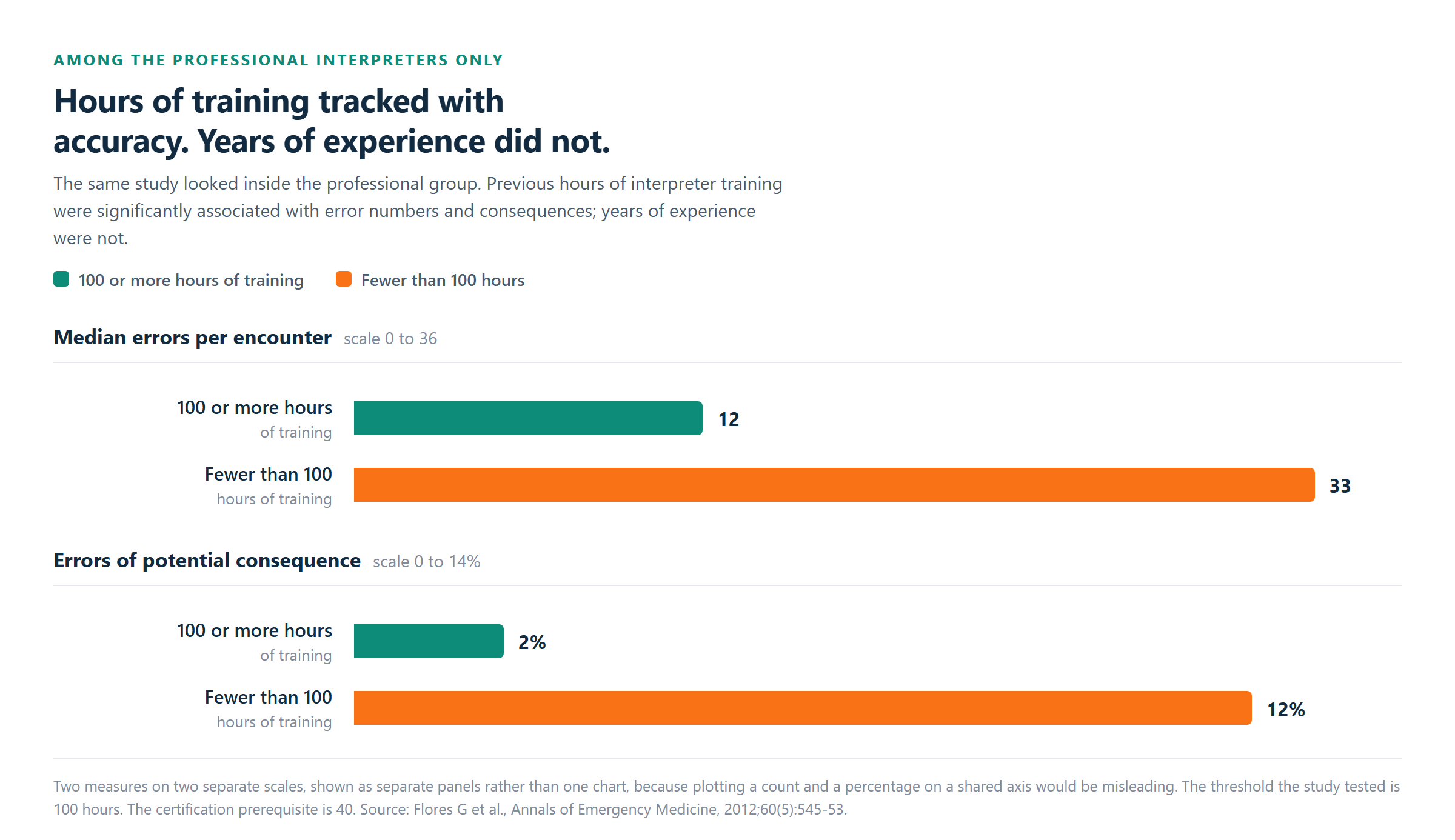
Time on the job did not separate the accurate interpreters from the less accurate ones. Training did, and the gap was large enough that the authors recommended “requiring at least 100 hours of training for interpreters” as something that “might have a major impact on reducing interpreter errors and their consequences in health care while improving quality and patient safety.”
If you are weighing whether the 40-hour requirement is a formality, that is the most direct answer in the literature: the training is the variable that moved.
Starting from zero? The 40 hours is the entry requirement for both national certifications, and there is no route around it. Our program covers it, at your own pace, for $289 and a full year of access. See the curriculum
How solid is this?
Worth being precise, because one study is one study.
- It is small and specific. 57 encounters, two hospitals, Spanish-language, pediatric emergency care. It is not a general finding about all interpreting everywhere.
- A 2024 systematic review found a more mixed picture. Published in Archives of Public Health, it reviewed the comparable studies from 1995 to October 2024. Error counts were significantly lower with professional interpreters than when family or friends interpreted, but not significantly lower than when untrained medical staff interpreted.
- That looks like a contradiction and is not. The review defined a professional interpreter as “people employed as interpreters, but with no specific requirements for education or experience.” So it compared job roles, and found the role alone did not settle it. The 2012 study looked inside that group at how much training each person had. Both point the same way: being employed as an interpreter is not the variable that matters. Training is.
- The review did not pool its studies. It found “critical methodological differences” between them and declined to run a statistical synthesis, noting that those differences and risk of bias “limit the conclusions drawn.”
- None of this measures patient outcomes. It measures interpreting errors and whether a reviewer judged they could have had clinical consequences. Related, but not the same thing.
- No study here evaluates any particular course, ours included. The variable is hours of training, not whose training it was.
The review’s own practical recommendations are worth repeating: use a professional interpreter first; if that is not possible, use medical staff without interpreting training before using family or friends; and keep sentences short and straightforward, which it associated with fewer omissions.
Why “I already speak both languages” is a different claim
The federal regulation on language access in health programs gives a sense of what the job actually asks. It defines a qualified interpreter as someone who has demonstrated proficiency in English and at least one other spoken language, who can interpret “effectively, accurately, and impartially… using any necessary specialized vocabulary or terms without changes, omissions, or additions and while preserving the tone, sentiment, and emotional level” of the original, and who adheres to generally accepted interpreter ethics including confidentiality.
Language proficiency is one clause of four. The rest is terminology, technique, impartiality and ethics, which is the part training addresses and fluency does not.
This is also why the certifying bodies do not count workplace experience toward the requirement. CCHI lists performing your own job as a bilingual employee among the activities that do not count toward the 40 hours. Interpreting at work, however often you do it, is not treated as training.
The number we are being straight about
The threshold in the 2012 study is 100 hours. The certification prerequisite, and our course, is 40.
Those are not the same number and we are not going to blur them. CCHI requires applicants “to have completed 40 hours of interpreter training specifically related to health care.” NBCMI requires a certificate of completion from a course of at least 40 hours, or a transcript showing at least 3 college credit hours. Neither body sets its prerequisite at the research threshold.
Anyone telling you that a 40-hour course makes you as accurate as the interpreters in that study is describing something the study does not say.
The honest reading is this: 40 hours is where you start, not where the curve flattens. The evidence points toward training continuing to help well past the certification minimum. That is an argument for treating the 40 hours as the first deliberate block of training in a career, and for continuing afterwards.
It is also worth repeating CCHI’s own caution, which applies to every provider in this market including us: “Interpreters are cautioned to question the veracity of guarantees of success on examinations as a result of any training.”
What to do next
1. Work out which certification you are aiming at. The two national bodies have different requirements and one of them is changing in January 2027. We keep plain-language explainers of CCHI’s requirements and NBCMI’s requirements, plus a piece on the difference between a certificate and certification, which is the distinction that causes the most wasted money.
2. Complete the 40 hours. Both bodies require it, documented, before you can sit an exam.
Our 40-hour medical interpreter training is a structured program you work through at your own pace: 125 video lessons across 8 sections, 650 practice questions, a 100-question final exam, and a certificate documenting your 40 training hours. Instruction is in English, and you apply it to your own language pair, whether that is Spanish, Arabic, Mandarin or another.
Enrollment is $289, one time, for a full year of access. There is no auto-renewal. The year includes everything we add during it, and there is one free final-exam retake after a 14-day wait.
3. Keep going after it. On the evidence above, the 40 hours is the entry requirement rather than the finish line, which is part of why the enrollment runs for a year rather than until you pass.
Enroll or see the full curriculum
—
Sources
All checked 27 October 2026.
- Flores G, Abreu M, Barone CP, Bachur R, Lin H. “Errors of medical interpretation and their potential clinical consequences: a comparison of professional versus ad hoc versus no interpreters.” Annals of Emergency Medicine, November 2012; 60(5):545-53. doi:10.1016/j.annemergmed.2012.01.025. PMID 22424655. https://pubmed.ncbi.nlm.nih.gov/22424655/
- Lauridsen IG, Terkildsen MD, Sørensen LU. “A systematic review of whether the number of linguistic errors in medical interpretation is associated with the use of professional vs ad hoc interpreters.” Archives of Public Health, 18 December 2024; 82(1):235. doi:10.1186/s13690-024-01461-8. Open access. https://pmc.ncbi.nlm.nih.gov/articles/PMC11653638/
- Code of Federal Regulations, 2024 annual edition, 45 CFR 92.4, definition of “qualified interpreter for an individual with limited English proficiency,” via GovInfo. https://www.govinfo.gov/content/pkg/CFR-2024-title45-vol1/xml/CFR-2024-title45-vol1-sec92-4.xml
- Certification Commission for Healthcare Interpreters, interpreter training requirement. https://cchicertification.org/certifications/eligibility/interpreter-training/
- National Board of Certification for Medical Interpreters, prerequisites. https://www.certifiedmedicalinterpreters.org/prerequisites
Need certified translation or interpreting?
Tell us what you need and we’ll send a clear, no-obligation quote, usually within one business day.
Get a free quote