
Industries · Healthcare
Language access that keeps patients safe, and keeps you compliant.
HIPAA-compliant medical interpreting and certified document translation for hospitals, clinics, and health systems: qualified linguists, on demand and on site, meeting Section 1557 and Title VI.

Healthcare language access is the certified translation and qualified interpreting that let patients with limited English proficiency understand their care, a requirement under Section 1557 and Title VI, not a courtesy. A qualified medical interpreter is trained, tested, and bound to confidentiality; a family member or bilingual staffer is not.
Why it matters
In healthcare, a misunderstanding is a safety event
Two forces make language access non-negotiable, and they point the same direction.
Patient safety
When a patient can't understand a diagnosis, a consent form, or medication instructions, care goes wrong, missed history, medication errors, and consent that isn't truly informed. Accurate interpreting and translation aren't a courtesy; they're clinical safety.
The law
Title VI and Section 1557 of the ACA require providers that receive federal funds to give patients with limited English proficiency meaningful access, with qualified interpreters and translators. Falling short invites civil-rights complaints, funding risk, and litigation.
Compliance, covered
Built to meet the rules healthcare runs on
We don't just translate, we keep your language-access program defensible. Here's what we're built to satisfy.
Section 1557 (ACA)
Meaningful access for LEP patients and companions, with qualified interpreters and translators, provided in a timely way and free of charge.
Title VI
Meaningful access for people with limited English proficiency at any provider receiving federal financial assistance.
HIPAA
Protected health information handled to HIPAA standards, with confidentiality agreements and access limited to assigned linguists.
ADA
Effective communication for Deaf and hard-of-hearing patients, including American Sign Language interpreting by video or on site.
The Joint Commission
Supports patient-centered communication standards, the right language services, identified and delivered at the point of care.
Qualified, never ad-hoc
Trained, ethics-bound interpreters, not family members or minors. Where AI assists translation, a qualified human reviews critical content.
Requirements referenced: HHS Section 1557 final rule · Title VI, Civil Rights Act · Americans with Disabilities Act.
What we provide
Interpreting and translation, built for the clinic
The two things every LEP encounter needs, spoken interpreting in the moment, and written documents patients can understand.
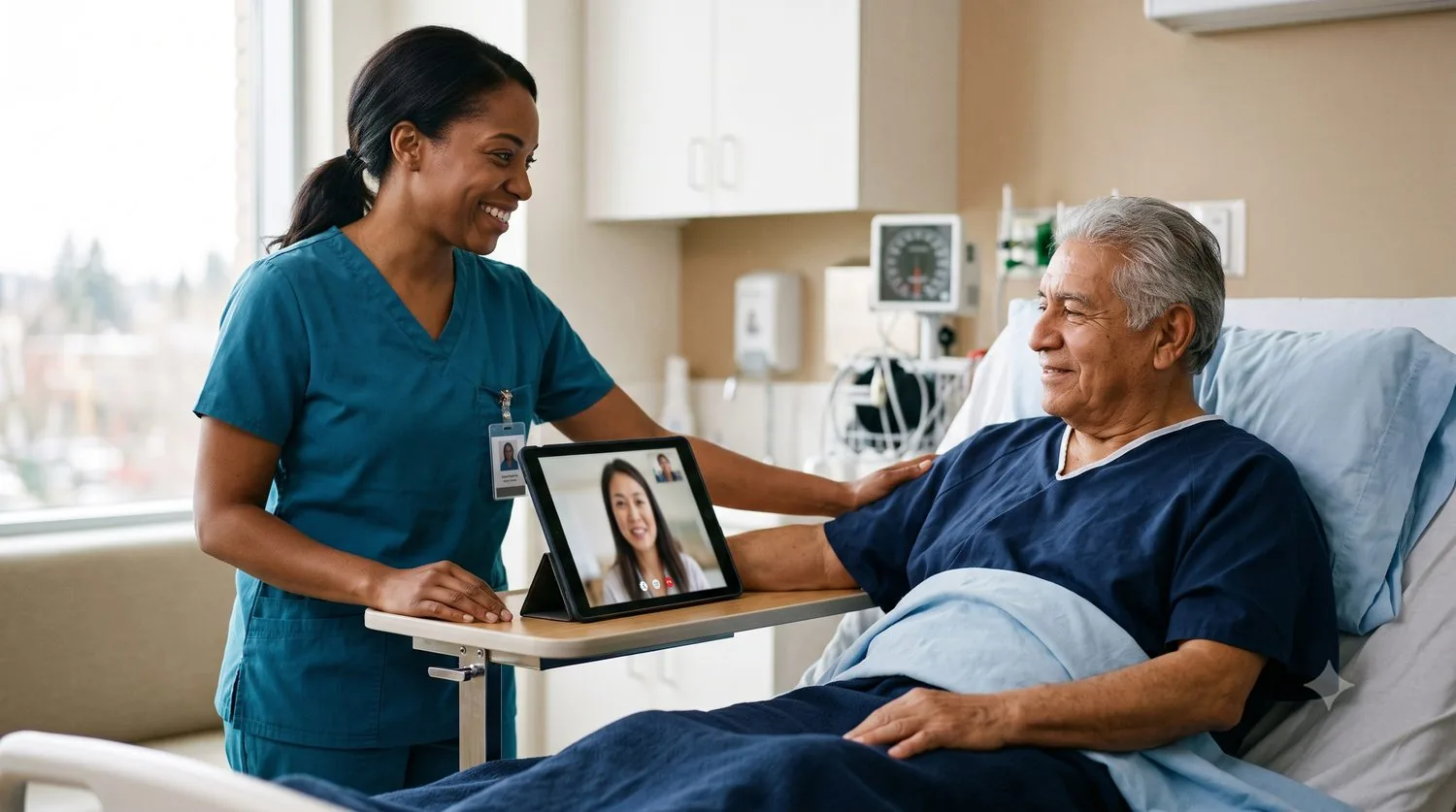
Medical interpreting
Connect a qualified medical interpreter in seconds, or schedule one in the room for the encounters that need presence.
- Over-the-phone (OPI) & video remote (VRI), 24/7
- On-site interpreters for complex & sensitive visits
- American Sign Language (ASL) by video or in person
- Interpreters trained to CCHI & NBCMI standards

Certified document translation
Certified translation of the documents patients rely on, accurate, formatted correctly, and reviewed by a qualified human.
- Consents, discharge instructions & medication guides
- Patient rights, notices & language-assistance taglines
- Signed certification statement for official use
- Consistent medical terminology across every document
What we translate
Every document in the patient journey, and beyond it
Healthcare translation runs from the "vital documents" federal guidance expects to the clinical, device, and regulatory content behind them. We cover the whole range.
- Informed consent forms
- Discharge & medication instructions
- Patient rights & grievance procedures
- Eligibility & denial notices, taglines
- Intake & medical history forms
- Clinical trial & informed-consent documents
- Study protocols & case report forms
- Diagnosis & prognosis reports
- Lab & pathology reports
- Instructions for use (IFUs) & device manuals
- Software & interface (UI) strings
- Technical & training materials
- Specifications & QA documentation
- Regulatory affairs submissions
- Drug labeling, inserts & product information
- GMP & quality-management documents
- Pharmacovigilance & safety reports
Need something not listed? If a patient, clinician, or regulator relies on it, we can translate it.
Not ready for a quote?
Talk through your Section 1557 and language-access requirements with a healthcare specialist, no obligation, or see exactly how our pricing works.
Why MLT
Why health systems choose us
We train the interpreters
Not just a pool we hire from, our own MLT Academy trains medical interpreters to the 40-hour CCHI & NBCMI standard.
One partner, the whole encounter
Interpreting, certified translation, and program guidance from one team, nothing slips through the gaps between vendors.
Technology we build ourselves
CertiDoc and InterpretManager give you speed and scale without trading away the accuracy a clinical setting demands.
Two decades in healthcare
20+ years serving hospitals, clinics, and health systems, language access you can defend to a surveyor.
Why qualified matters
A qualified interpreter vs. family or staff
| Qualified medical interpreter | Family / bilingual staff | |
|---|---|---|
| Trained & tested | Yes, to CCHI / NBCMI standards | No |
| Meets Section 1557 | Yes | No (permitted only in narrow emergencies) |
| Risk | Managed | Misdiagnosis, liability & privacy breach |
What must be translated
What Section 1557 treats as a “vital document”
Vital documents
What a patient needs to access or understand care, informed consents, discharge & medication instructions, patient rights & grievance procedures, eligibility & denial notices, and language-assistance taglines. These come first under Section 1557.
Supporting content
The clinical, research, medical-device, and regulatory material behind the care. Translated as your program needs, important, but not what a surveyor checks for language access first.
How we work: we start with your vital documents so your language-access program is defensible, then extend to the clinical and regulatory content behind them.
Healthcare FAQ
Questions compliance teams ask
Yes. Our medical interpreters meet the "qualified interpreter" standard under Section 1557, proficient, accurate, impartial, and fluent in medical terminology, and train to the 40-hour CCHI and NBCMI standards through MLT Academy. Certified interpreters are available for the languages where national certification exists.
Yes. We operate HIPAA-compliant workflows: protected health information is encrypted in transit and at rest, access is limited to the assigned linguist, and every engagement is covered by a confidentiality agreement.
Covered providers must take reasonable steps to give patients with limited English proficiency, and their LEP companions, meaningful access, using qualified interpreters and translators, provided in a timely manner and free of charge. It also calls for a notice of nondiscrimination with taglines in the most common languages in your state.
Generally, no. Under Section 1557, an unqualified adult may only interpret temporarily in an emergency while a qualified interpreter is found, or when the patient specifically requests it. Minors may interpret only in a life-threatening emergency when no qualified interpreter is available. In practice, a qualified interpreter should always be your default.
"Vital documents", anything that affects a patient's access to or understanding of care. That typically includes informed consents, discharge instructions, patient rights, grievance procedures, eligibility and denial notices, language-assistance taglines, and intake forms. We translate all of these, certified where required.
On-demand phone and video interpreting connects in seconds, around the clock. On-site interpreters are scheduled to your dates and location. American Sign Language is available by video remote interpreting or in person, to meet ADA effective-communication requirements.
Thank you immensely for your help with the Korean translations needed for my husband's medical treatment. Your support has been invaluable, making a meaningful impact.
Heidi C. · MLT client
One US-based partner for interpreting, certified documents, and AI-assisted translation, verified by professional human linguists.
Trusted by healthcare and public-health organizations


Give every patient the words to be understood.
Tell us about your language-access needs and we'll build the right mix of interpreting and translation, with a clear, no-obligation quote, usually within one business day.