
Legal
What Makes a Legal Translation Court-Ready?
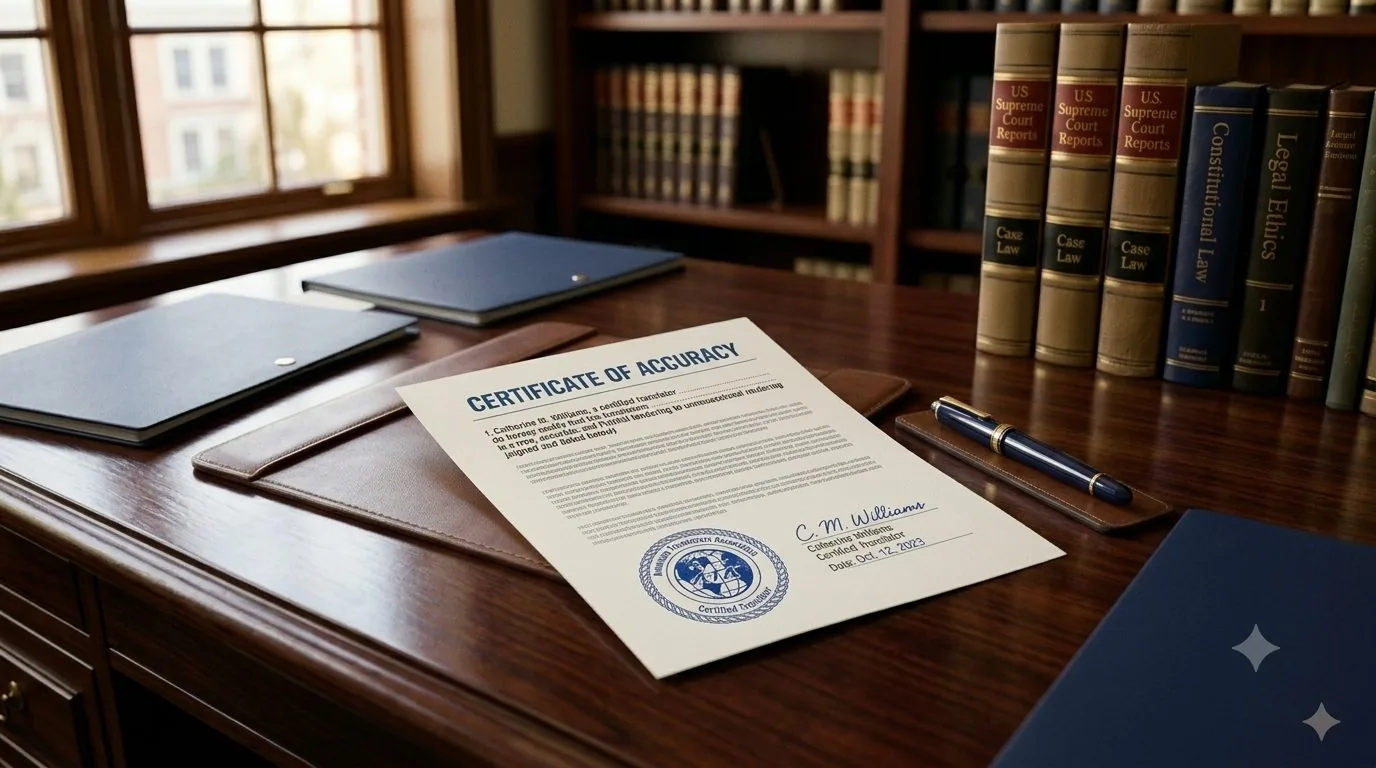
A court-ready legal translation is a complete, accurate rendering of a source document paired with a translator’s signed Certificate of Accuracy. It preserves every word, seal, and stamp, keeps legal terminology consistent, and is prepared to meet court and agency requirements. Admissibility ultimately rests with the court, but proper certification removes the avoidable obstacles.
What does “certified” actually mean?
Certification is often misunderstood. A certified translation is a full, faithful translation of the source document accompanied by a signed statement, the Certificate of Accuracy, in which the translator attests that the translation is complete and accurate to the best of their knowledge. Nothing is summarized, omitted, or added.
Two other steps are sometimes requested alongside certification, and they are frequently confused with it:
- Notarization verifies the identity of the person signing the certificate. A notary does not evaluate translation quality or accuracy; they confirm who signed.
- An apostille authenticates a document so it can be recognized in another country that is party to the Hague Convention. It is about cross-border acceptance, not linguistic quality.
When a matter reaches beyond U.S. borders, or when a receiving authority specifically asks for one of these, we coordinate the additional step. For most domestic filings, a signed Certificate of Accuracy is what courts and agencies expect.
Why do accuracy and completeness matter so much?
In litigation, a single mistranslated clause can shift the meaning of a contract, a statement, or a piece of evidence. Court-ready work holds to two non-negotiable standards: accuracy, meaning the translation faithfully conveys the source without distortion, and completeness, meaning every element is carried over, including handwritten notes, stamps, signatures, and margin annotations, often flagged with bracketed translator’s notes.
This is why machine output alone does not clear the bar for filings, exhibits, and evidence. A qualified human linguist reads context, resolves ambiguity, and understands that in a legal document, small choices carry weight.
How is legal terminology kept consistent?
Legal language is precise and unforgiving. The same term must be translated the same way every time it appears, across a single document and across an entire matter. To hold that line, we build case-specific glossaries and terminology databases so that a term of art rendered on page one reads identically on page four hundred.
Consistency also protects you during discovery and cross-examination. When opposing counsel scrutinizes wording, uniform terminology means the translation withstands the pressure instead of inviting disputes over what a word was supposed to mean.
How is confidentiality and privilege protected?
Legal documents are among the most sensitive materials a business handles. We treat confidentiality as the default, not an upgrade. Every engagement is covered by non-disclosure agreements, access is limited to the assigned linguist working on your matter, and files are handled securely throughout the project.
That controlled access matters for privilege. Limiting who touches privileged material, and documenting that handling, helps preserve the protections your case depends on. If your firm has its own security or NDA requirements, we work within them.
What is the difference between legal translation and court interpreting?
The two are related but distinct disciplines, and using the right one matters.
- Certified legal translation is written. It converts documents, contracts, filings, exhibits, and evidence from one language to another, and it comes with a Certificate of Accuracy.
- Court interpreting is spoken. Interpreters render live testimony, hearings, and depositions in real time. Court interpreters are certified or qualified and oath-bound, sworn to interpret faithfully.
For scale, roughly 330,000 federal court interpreter events take place each year, about 96% of them in Spanish, spanning more than 100 languages (Administrative Office of the U.S. Courts, FY2013, 2016). Written matters and spoken proceedings call for different specialists, and we provide both.
How does MLT handle legal matters and large document review?
MLT is a U.S.-based, ATA member firm with more than 20 years of experience and coverage across 300+ languages. For legal clients, that means a workflow built for the realities of litigation: high volume, tight deadlines, and zero tolerance for error.
Large document review, the kind that arises in discovery, multidistrict litigation, and cross-border deals, is where a structured process earns its keep. We scope the collection, assign qualified legal linguists, enforce shared glossaries, and layer in quality review so that thousands of pages stay consistent and defensible. You can learn more about our work with legal clients and our certified translation services.
When a filing deadline is real and the stakes are high, you want a partner who has done this before. Contact MLT to discuss your matter, or call 408-970-9586.
Frequently asked questions
Is a certified translation automatically admissible in court?
Not automatically. A certified translation is prepared to meet court and agency requirements, but admissibility ultimately rests with the court based on the rules of the jurisdiction and the specifics of your case. Proper certification removes common procedural obstacles and gives the court what it typically expects.
Do I need notarization or an apostille for my legal translation?
It depends on the receiving authority. Notarization verifies the signer’s identity, and an apostille authenticates a document for use in another Hague Convention country. Many domestic filings need neither; others require one or both. Tell us where the document is going and we will advise and coordinate the right steps.
How does MLT protect confidential and privileged documents?
Confidentiality is our default. Work is covered by non-disclosure agreements, access is limited to the assigned linguist, and materials are handled securely from intake through delivery. If your firm has specific security protocols, we operate within them.
Need certified translation or interpreting?
Tell us what you need and we’ll send a clear, no-obligation quote, usually within one business day.
Get a free quote