
Certified Translation
Certified vs. Notarized Translation: Which Do You Actually Need?
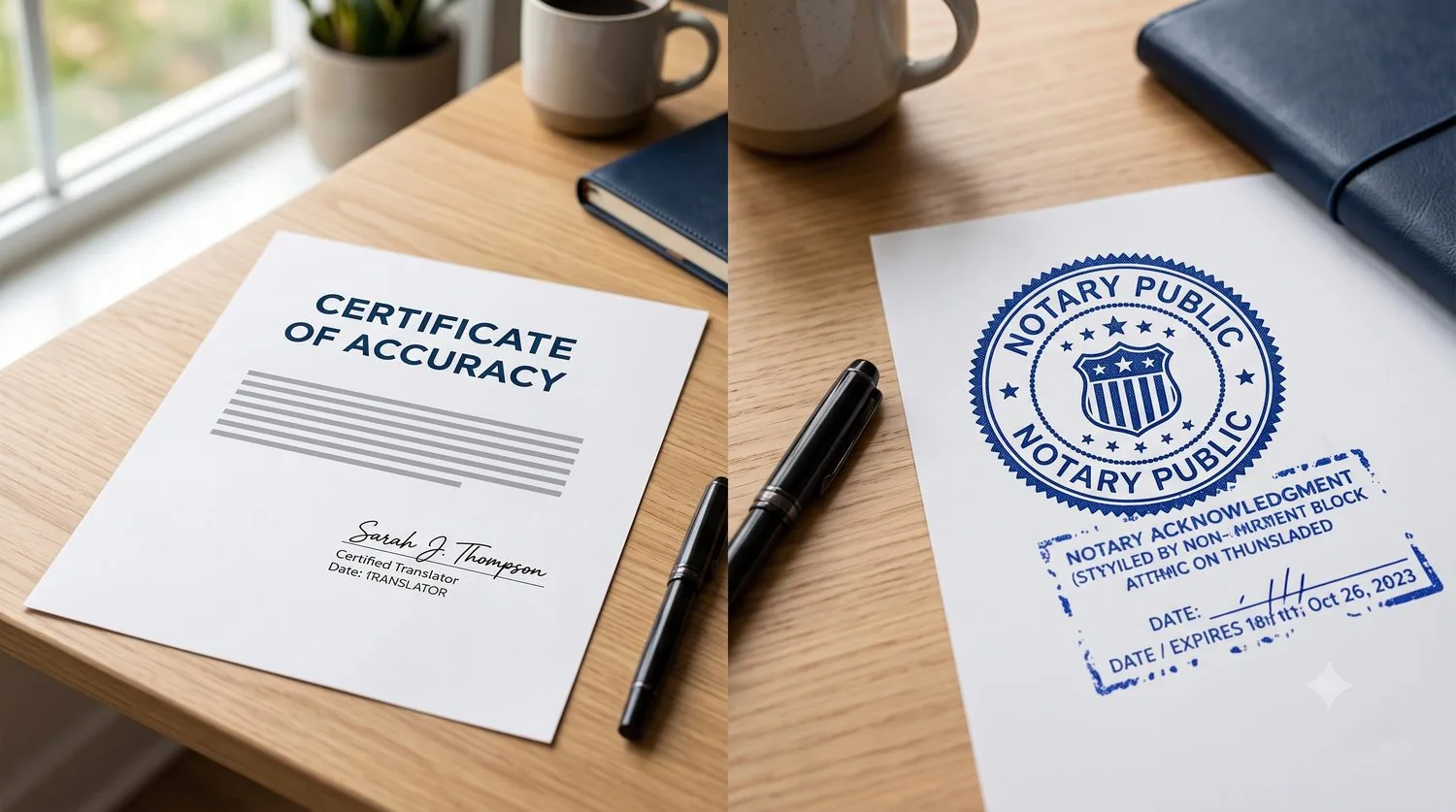
Certified translation and notarized translation are not the same thing. A certified translation is a complete, accurate translation accompanied by the translator’s signed Certificate of Accuracy. Notarization only means a notary public verified the signer’s identity, it says nothing about translation quality. For most official U.S. purposes, including USCIS, you need certification, not notarization.
What is a certified translation?
A certified translation is a full, accurate rendering of your original document plus a signed statement, often called a Certificate of Accuracy, in which the translator or translation company attests that the translation is complete and correct to the best of their knowledge. That statement typically includes the translator’s name, signature, contact information, and the date.
The certificate is what makes the translation “certified.” It ties a qualified human to the accuracy of the work and gives the receiving agency someone accountable for it. It does not require a notary, a stamp from a court, or any government seal. The translator’s signed attestation is the certification.
What is a notarized translation?
A notarized translation adds one extra step: after the translator signs the Certificate of Accuracy, a notary public witnesses that signature and applies a notarial seal. Here is the part people miss, the notary is only confirming who signed the document, not whether the translation is any good.
A notary has no obligation, and usually no ability, to judge translation accuracy. They verify the signer’s identity, plain and simple. So notarization is a layer of identity verification stacked on top of a certified translation; it is not a higher grade of translation.
Does USCIS require certified or notarized translation?
For U.S. immigration, the answer is clear. USCIS requires a certified translation, not a notarized one. Federal regulation 8 CFR 103.2(b)(3) states that any document in a foreign language must be accompanied by a full English translation that the translator certifies as complete and accurate, along with the translator’s certification that they are competent to translate.
Nowhere does that rule ask for notarization. If you are filing for a green card, naturalization, a visa, or submitting birth certificates, marriage certificates, or academic records to USCIS, a properly certified translation is what you need. Paying extra for a notary usually adds cost and delay without adding anything USCIS actually wants.
When would I actually need notarization or an apostille?
Notarization becomes relevant when the entity receiving your document specifically demands it. This is common with certain foreign authorities, some courts, a handful of state and local agencies, and particular universities or licensing boards. Their rules, not U.S. immigration law, drive the requirement.
You may also encounter a request for an apostille. An apostille is a certificate that authenticates the origin of a public document for use in another country under the Hague Apostille Convention. It is issued by a designated government authority, not by your translator. In practice, a foreign court or ministry might ask for a certified translation, a notarized signature, and an apostille together. Always confirm the exact combination before you order anything.
How do I decide which one I need?
The safest approach is to ask the receiving institution directly and follow their instructions to the letter. A few reliable guidelines:
- Filing with USCIS or most U.S. federal agencies? A certified translation is what’s required.
- Submitting to a foreign government, court, or consulate? Ask whether they want notarization or an apostille in addition to certification.
- Dealing with a university, court, or licensing board? Check their published document requirements, many spell out exactly what they accept.
- Not sure? Get the requirement in writing from the receiving party before ordering. It is far cheaper than redoing the job.
When the requirements are ambiguous, certification alone is the standard baseline. Notarization and apostilles are add-ons you request only when someone specifically asks for them.
How does MLT handle certified and notarized translation?
At MultiLingual Technologies, every project is completed and verified by professional human linguists, we do not hand your official documents to raw machine output. Each certified translation ships with a signed Certificate of Accuracy that meets USCIS requirements and the standards of most U.S. agencies.
When your situation calls for more, we can arrange notarization of the certifying signature and guide you on obtaining an apostille where needed. As a U.S.-based, U.S.-owned firm with more than 20 years of experience and coverage of over 300 languages, we make sure you get the correct format the first time. We are an ATA member firm, and our team can help you confirm what your receiving agency requires before we begin.
Not sure whether you need certification, notarization, or both? Contact us for a free quote and we’ll help you order exactly what your document requires, nothing more, nothing less. You can also reach us by phone at 408-970-9586 from our office in Santa Clara, CA.
Frequently asked questions
Is a certified translation the same as an ATA-certified translation?
No. A certified translation simply means the work comes with a signed Certificate of Accuracy. MLT is an ATA member firm, and our qualified human linguists provide that certification with every official translation.
Does USCIS ever require notarization?
No. USCIS requires certification under 8 CFR 103.2(b)(3), not notarization. A notary only verifies the signer’s identity, which is not something USCIS asks for on translated documents.
Can you notarize a translation after it’s certified?
Yes. If your receiving agency requires it, we can arrange for a notary to witness and seal the certifying signature, and we can advise you on apostilles for international use.
Need certified translation or interpreting?
Tell us what you need and we’ll send a clear, no-obligation quote, usually within one business day.
Get a free quote