
Industries · Education
Meaningful access, in every family's language.
Certified translation of the documents families must understand and qualified interpreting for the meetings where decisions are made, for K-12 districts and higher ed, in 300+ languages, with 20+ years of experience.

Language access in education is the professional translation of school documents and qualified interpreting at meetings that let limited-English-proficient families take part in their children's education, a Title VI civil-rights duty. A qualified interpreter is trained and impartial; a student or family member is neither.
Why it matters
Language access is a civil right, not a courtesy
Two reasons getting it right matters for every family, and every district.
A legal duty, and equity
Federally funded schools must take affirmative steps so limited-English-proficient students and parents can meaningfully participate, a national-origin civil-rights obligation, not an optional service. Gaps invite complaints and, more importantly, shut families out of their children's education.
Accuracy in high-stakes documents
In special education, disciplinary hearings, and consent forms, a mistranslation or an unqualified interpreter can invalidate consent and produce a legally defective IEP. These are exactly the contexts where untrained staff, students, or family members must not be used.
Built for the duty schools carry
The standards language access in education runs on
We help districts meet obligations grounded in statute and Supreme Court precedent.
Title VI language access
Federally funded schools may not discriminate by national origin and must take affirmative steps for LEP students and families (Title VI; Lau v. Nichols).
Essential information for parents
Schools must convey what they share with all parents to LEP parents in a language they understand, report cards, registration, discipline, special-ed, and consent.
Overcome language barriers
Schools and agencies must take appropriate action to overcome language barriers impeding equal participation (Equal Educational Opportunities Act, 20 U.S.C. §1703(f)).
Qualified, not family or students
Interpreters and translators must be competent and trained; districts should not rely on students, siblings, or untrained staff, especially for IEP, discipline, and consent.
Accurate special-education work
Evaluations, notices, and IEP documents and meetings require accurate translation and qualified interpretation so parents can give informed consent (IDEA; Section 504; Title VI).
Credentials & confidentiality
Certified translation of foreign transcripts and diplomas for evaluators like WES, with student records handled consistent with FERPA obligations.
Requirements referenced: Title VI language-minority policy · Equal Educational Opportunities Act (20 U.S.C. §1703(f)) · WES translation requirements · FERPA.
What we provide
Translation for documents, interpreting for meetings
The two things a family needs to take part, in writing, and in the room.
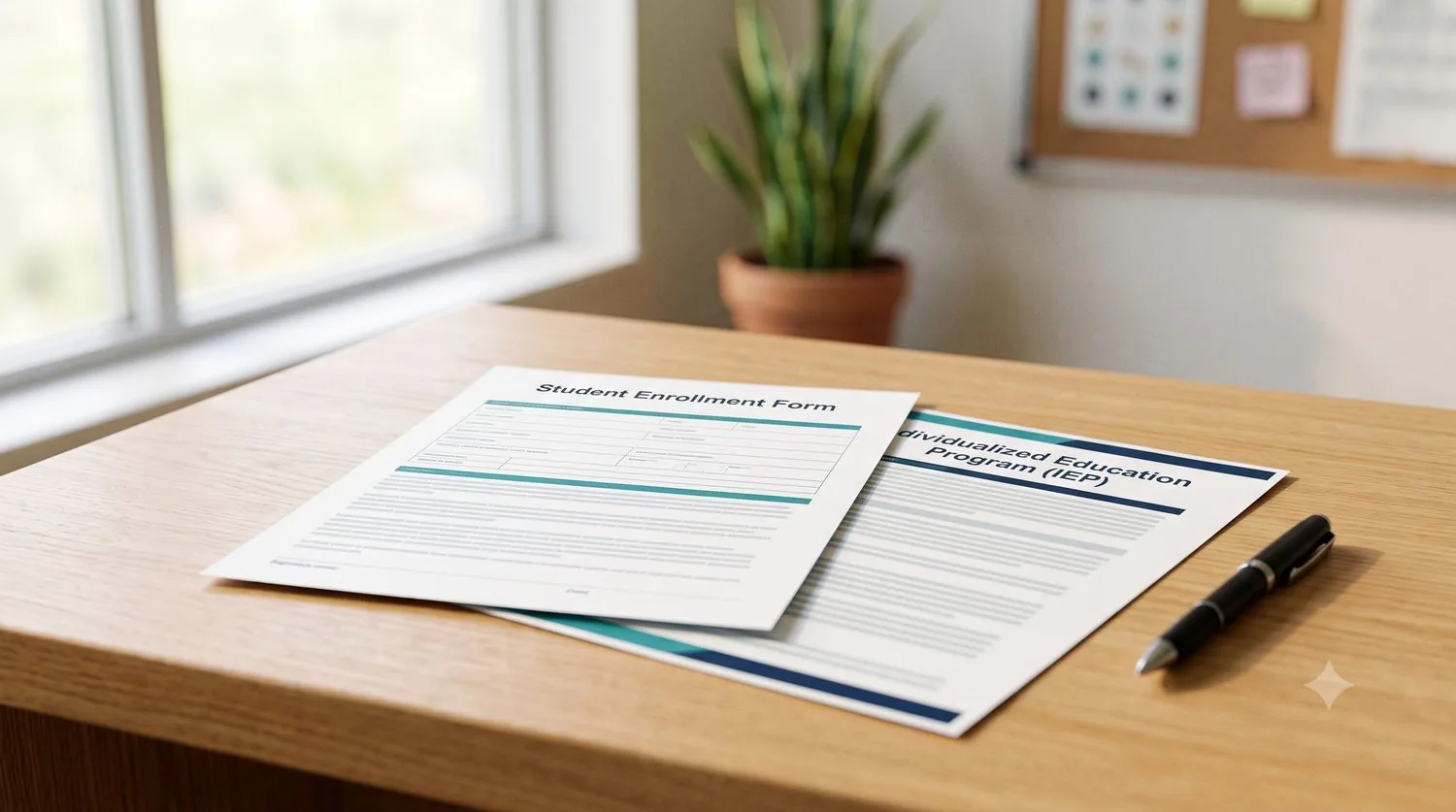
Translation of school documents
Certified and standard translation of the documents families must understand, with terminology consistent across your whole document set.
- Family communications & notices
- Enrollment, records & consent forms
- IEP & special-education documents
- Certified transcripts for WES

Interpreting for meetings
Qualified interpreters, never students or family members, for the conversations that shape a child's education.
- Parent-teacher conferences
- IEP & 504 meetings
- Disciplinary hearings & enrollment
- Phone, video & on-site
What we translate
Across the school year, and the system
From a first enrollment form to a graduate transcript.
- Report cards & progress reports
- Handbooks & codes of conduct
- Newsletters & notices
- Attendance & discipline letters
- Registration & enrollment forms
- Home-language surveys
- EL identification & placement
- Transcripts & school records
- Evaluations & eligibility reports
- IEPs & 504 plans
- Prior written notice & consent
- Procedural safeguards
- Foreign transcripts & diplomas
- Certified for WES / NACES
- International-student materials
- Admissions & orientation
Translating a district's whole document set? Translation memory keeps terminology consistent, and cost down, across every school.
Meeting or deadline coming up?
Talk through your language-access needs with an education specialist, no obligation, or see how our pricing works.
Why MLT
Why districts & institutions choose us
300+ languages, one vendor
A deep bench across the rare and common languages districts actually encounter, backed by ATA membership and 20+ years.
Certified, done right
Accurate certified translations that hold up for credential evaluators, IEP consent, and family communications.
Qualified interpreters
Phone, video, and on-site interpreters for conferences, IEP and 504 meetings, and hearings, never students or family members.
Consistent & confidential
Translation-memory-driven terminology consistency across a district's whole document set, with FERPA-conscious handling of student records.
Why qualified matters
A qualified interpreter vs. a student or family member
| Qualified interpreter | Student / family member | |
|---|---|---|
| Trained & impartial | Yes | No |
| For IEP & consent | Appropriate | Not appropriate, risks defective consent |
| Confidentiality | Bound by it | Not bound |
What must reach families
The documents families need in their language
Essential family communications
Enrollment & registration, special-education (IEP) documents, disciplinary & attendance notices, health & consent forms, and report cards.
Programs & compliance
Title I and Title III notices, language-access plans, family handbooks, and district-wide communications.
Bottom line: under Title VI and the EEOA, districts must give limited-English-proficient families essential information in a language they understand.
Education FAQ
Questions districts ask
Providing limited-English-proficient families and multilingual students meaningful, equal access to schooling through professional translation of documents and qualified interpreting at meetings, a Title VI civil-rights obligation, not an optional service.
Federally funded schools must communicate essential information to LEP parents in a language they understand, under Title VI, the Equal Educational Opportunities Act, and Lau v. Nichols, durable legal duties grounded in statute and Supreme Court precedent.
For high-stakes contexts, IEP, discipline, consent, no. Federal guidance calls for qualified, trained interpreters; students and family members risk inaccuracy and breach confidentiality.
Yes, translation of evaluations, notices, and IEP and 504 documents, plus qualified interpreting for IEP and eligibility meetings so parents can give informed consent.
Yes, we provide certified, accurate translations formatted to meet credential-evaluation requirements such as WES and NACES. (The evaluator assesses the credential; we provide the certified translation.)
We treat student records and their translations as confidential and handle them consistent with FERPA obligations for vendors acting on a school's behalf.
One US-based partner for interpreting, certified documents, and AI-assisted translation, verified by professional human linguists.
Reach every family, in their language.
Tell us about your documents and meetings, you'll get a clear, itemized quote, usually within one business day.