
Uncategorized
Introducing BabelBee: AI Document Translation, Verified by Linguists
Where 20 Years of Certified Translation Meets AI Speed
Today we are launching BabelBee, an AI-powered document translation platform built on Multilingual Technologies’ two decades of certified linguistic expertise. BabelBee translates Word, PDF, Excel, PowerPoint, subtitles, and scanned files in minutes. It runs every translation through a second-model quality check. And it routes flagged segments to our certified linguists for human review before export.
The launch reflects what we have believed for years. AI and human expertise are not competing approaches to translation. They work together to deliver outcomes neither can achieve alone.
Why We Built BabelBee
The AI translation market in 2026 forces organizations into a tough choice. On one side, machine translation tools offer speed and scale. They also ask buyers to accept errors, omissions, and cultural missteps as the cost of doing business. On the other, traditional human translation workflows preserve accuracy. But their timelines and budgets no longer match the speed of modern work.
For documents that really matter, neither path is good enough on its own. Contracts. Patient records. Regulatory filings. Technical manuals. Marketing materials that carry your brand. A fast translation that introduces legal ambiguity is not actually fast. A perfect translation that arrives three weeks late may be too late to use.
We built BabelBee because you should not have to choose between these failure modes. We have spent twenty years helping clients navigate exactly this tension through our human-led services. BabelBee brings that same hybrid thinking into a self-serve platform.
Building Trust in AI-Powered Transcription
A standout workshop was led by the Lawrence County Common Pleas Court, focusing on AI-generated court transcripts. Their pilot project showcased real-time speech-to-text tools that courts are beginning to use to supplement or accelerate transcription.
The results were promising, with hearings transcribed in minutes rather than days. However, the message was consistent: AI cannot work alone. Every transcript still requires human review and correction. We found it encouraging to see courts actively experimenting with this technology while staying grounded in the need for quality control and legal accountability.
We were particularly interested in how this kind of AI could benefit interpreters. Accurate transcripts provide interpreters with better reference material before and after proceedings. AI-enhanced transcription, when implemented correctly, could help us prepare more efficiently and ensure better language access outcomes.
How BabelBee Works
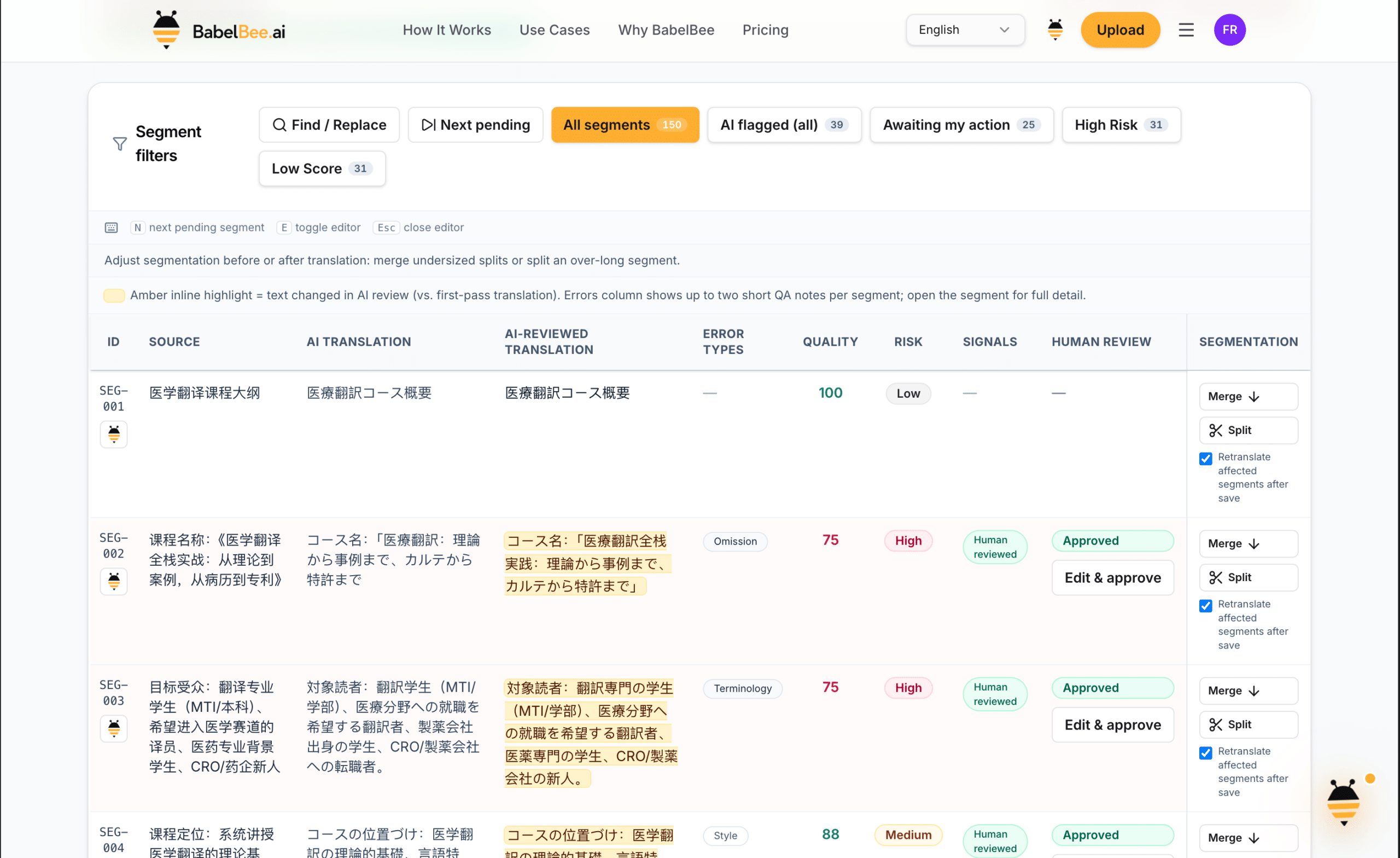
The workflow is simple. You upload a document in any of the supported formats: Word, PDF, Excel, PowerPoint, subtitle files, or scanned images. BabelBee’s AI translates the content right away and keeps formatting, layout, and structure intact.
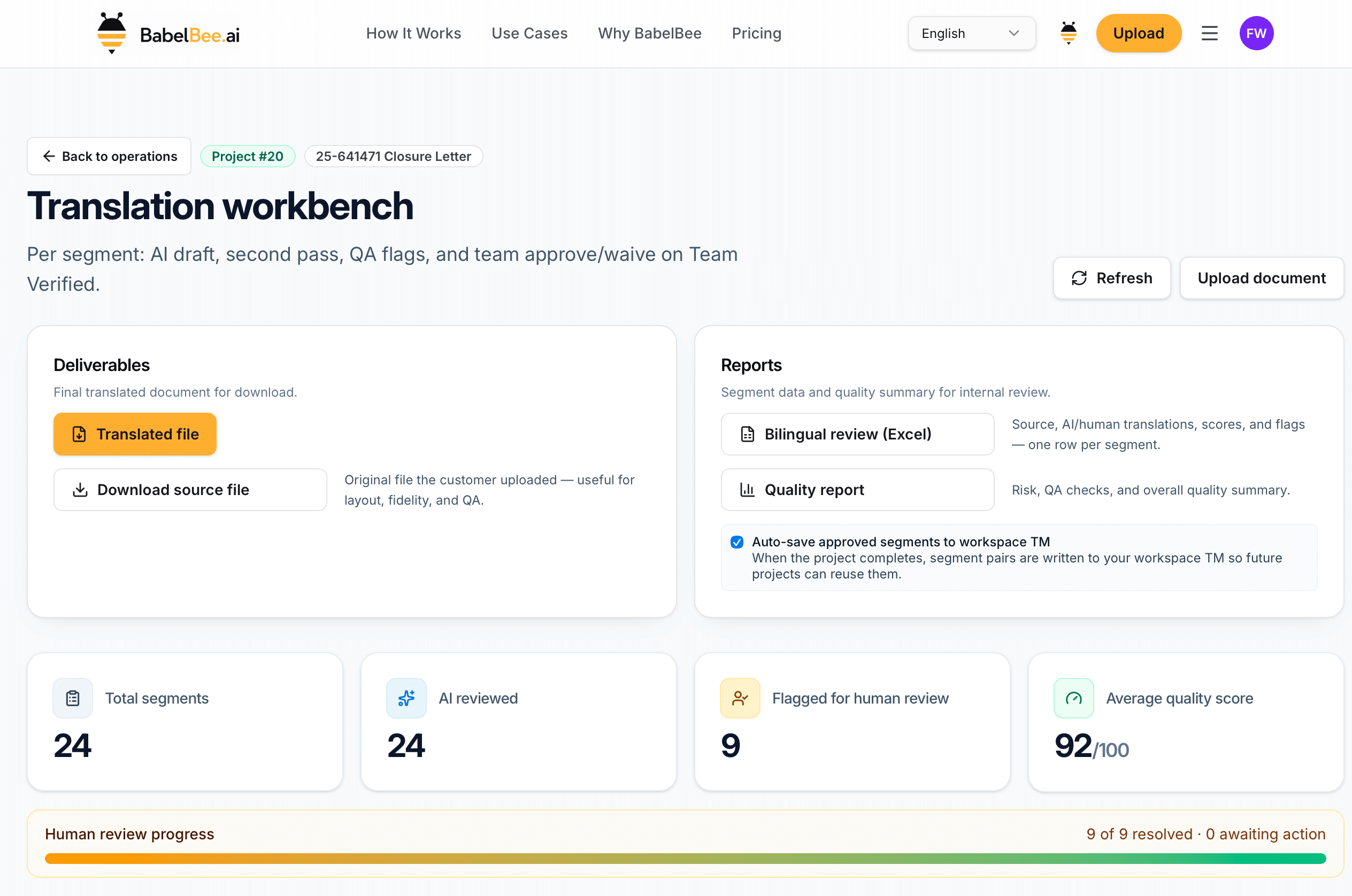
A second AI model then reviews the translation. This second-model QA pass is one of BabelBee’s most important features. Rather than trusting a single engine, BabelBee uses a different AI to evaluate the first model’s output. It flags segments where the two disagree, where confidence is low, or where context suggests higher risk of error.
Those flagged segments enter our Team Verified workflow. There, MLT’s certified translators review, refine, and approve the AI’s work before the document is finalized. You see exactly which segments were verified by humans and which the AI translated with high confidence. You get full visibility into the final output.
Shared workspaces, glossaries, and translation memory round out the platform. They keep your translations consistent across documents and over time. Teams can agree on terminology, lock in approved phrasings, and build shared translation assets that grow more valuable with use.
Built for the Documents That Matter
BabelBee is purpose-built for content where accuracy is not negotiable.
Legal teams use it for contracts, NDAs, and discovery documents where a single mistranslated clause can shift liability. Medical organizations rely on it for patient communications, clinical notes, and regulatory submissions where errors can harm patients. Technical writers use it for product documentation that must work identically in every language a product ships in.
Marketing teams have found particular value in BabelBee’s brand-aware workflows. While AI handles the bulk translation, our linguists review brand voice, cultural references, and tone in the segments that define how a company presents itself in a new market.
These use cases share one thing. The cost of a mistranslation in high-stakes content is always higher than the cost of human verification. BabelBee’s architecture is built around that reality..
What This Means for You
If your organization already works with Multilingual Technologies, BabelBee offers a second track for projects where AI assistance can speed up turnaround without lowering the quality standards we have built our reputation on. Many of our clients have asked, over the past few years, how to safely bring AI into their translation workflows. BabelBee is our answer.
If you are new to MLT, BabelBee gives you self-serve access to our certified linguists. Previously, you would have needed a traditional services contract. The platform scales from a single document to enterprise deployments, with pricing that matches the actual mix of AI and human work in your project.
In both cases, the underlying expertise is the same. The certified linguists who power our translation, interpretation, and localization services are the same translators who verify BabelBee’s flagged content.
Why the Hybrid Model Wins
Anyone who has read our reflections from industry conferences over the past few years will recognize a consistent theme. From GALA in Montreal to the Ohio Court Technology Conference, we have argued that AI should support, not replace, professional linguists. We have applied that principle to our interpreting services, our quality assurance processes, and our internal workflows.
BabelBee is that same philosophy built into a translation product. It rejects the idea that AI replaces human expertise. It also rejects the idea that AI has no place in translation. Both positions, in our experience, miss where the technology actually creates value.
The truth sits in the middle. AI is excellent at high-volume, pattern-matched translation work. It struggles with cultural nuance, specialized terminology, and the judgment calls that separate a competent translation from an excellent one. A well-designed system uses each capability where it is strongest. BabelBee is our attempt to build exactly that system.
Looking Ahead
BabelBee launches today, but it does not stop here. Over the coming months we will expand language coverage. We will deepen integrations with the document management systems our clients already use. We will add capabilities for specialized content types like legal e-discovery and clinical research documentation.
We are also exploring how BabelBee’s hybrid model might extend beyond document translation. Real-time meeting translation with verified glossaries. Subtitle workflows with linguist-reviewed transcreation. Translation memory that learns and grows from our team’s collective work.
The broader commitment is unchanged. As AI capabilities continue to advance, our role is to integrate them responsibly into a translation practice that has always been about getting language right.
We invite you to try BabelBee on a real document. Upload something that matters. See how the workflow handles it. Tell us what you find.
Try BabelBee on a Real Document
See your file translated in minutes, with our certified linguists verifying the segments that matter most.
Need certified translation or interpreting?
Tell us what you need and we’ll send a clear, no-obligation quote, usually within one business day.
Get a free quote